
After a thunderstorm hits your property, you might inspect the siding and roof for issues. You may also want to figure out how to identify storm damage on trees. If your trees have hanging limbs or splintered trunks, it’s time to call an arborist offering tree services in Carlton, OR.
Learn more about the signs that a tree has damage that requires the skills of a professional.
The Tree Is Now Leaning
After a lot of rain softens the ground underneath the tree, the roots might struggle to keep the trunk upright.
Even if the tree only shifts a few inches from its previous upright position, this shift can indicate significant problems with the root structure. An arborist can use cabling to support the trunk until the roots recover.
Broken Branches That Are Still Attached
When branches don’t completely break loose during a storm, they may hang in the upper canopy instead of falling to the ground. It can be difficult for a homeowner to spot these areas of damage while standing on the ground. An arborist can use a crane and ladders to inspect the canopy.
Cracks in Places Where Limbs Meet
One of the most difficult steps in how to identify storm damage on trees lies in spotting subtle cracks in limbs. When those cracks are at locations where the limb splits into a second branch, it’s especially dangerous for the health of the tree.
However, these cracks are often difficult for homeowners to see. Professional arborists have the experience necessary to spot tiny cracks. They can determine which of these cracks have the highest likelihood of increasing in size from the weight of the limb.
Arborists can use cables and braces to try to support the cracked limb, giving it time to heal.
Splits in the Trunk
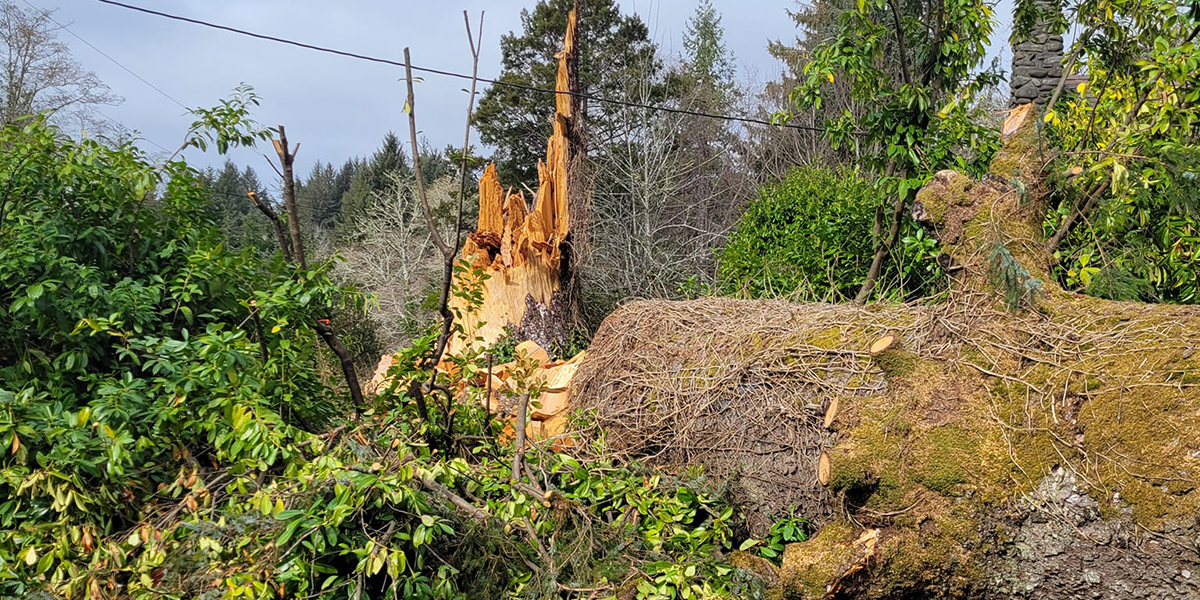
During a windstorm, the tree might experience significant stress on the trunk. Leaves covered in rain and water-soaked bark will increase the weight of the limbs that sprout away from the trunk, increasing the chances of a split occurring.
If you see the beginning of a trunk split, contact an arborist for help with bracing and trimming.
Bark That Falls Off
Heavy rain might cause loose or damaged bark to slide off the tree. This could expose a large cavity in the trunk that’s dangerous to the tree’s long-term health. If you see damaged bark after a storm, call for help.
After a Storm, Count on Oregon Arborist for a Full Assessment of Your Trees’ Health
Not all signs of tree problems are easy to identify after severe rain or wind. Learning how to identify storm damage on trees might require the expertise of our certified arborists. We can look for subtle cracks or exposed roots that could worsen in the near future.
If you see leaning trees or uprooted trees after stormy weather, the tree’s health is in jeopardy. You may also know the dangers of curved trees. If you’d like help with spotting subtle problems and broken branches high in the canopy, though, call Oregon Arborist today at (503) 899-4166.